

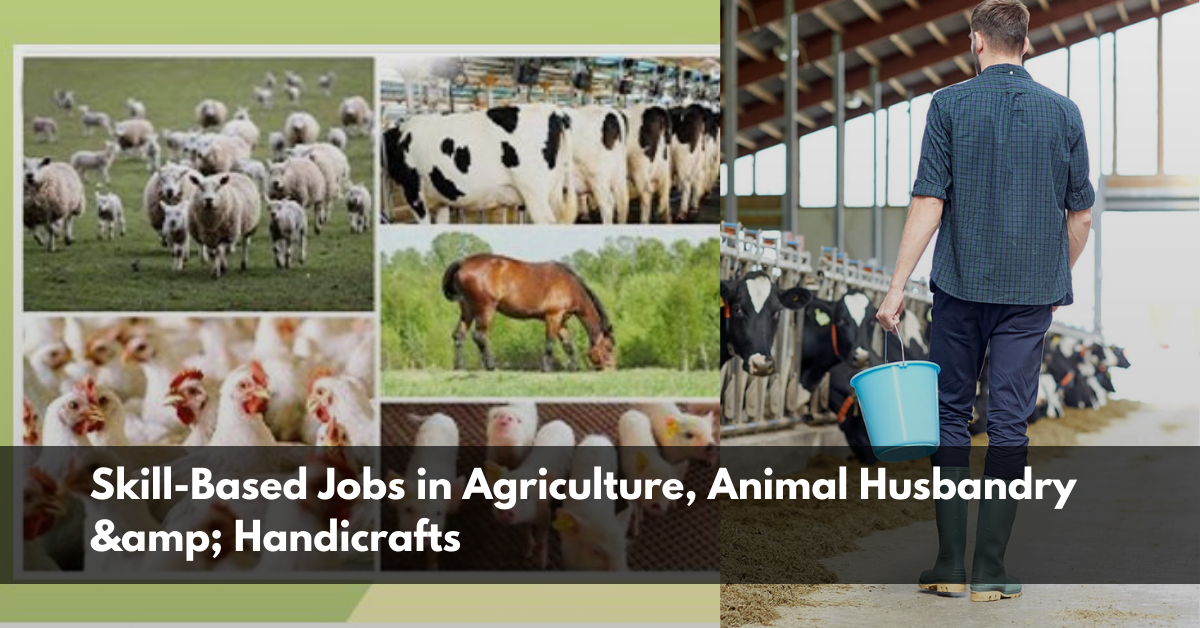
In a country like India, where nearly 65% of the population still lives in rural areas, the role of agriculture, animal husbandry, and handicrafts in providing employment cannot be underestimated. Traditionally, these sectors have been seen as low-income or subsistence-based, but with modernization, training, and skill development, they are now evolving into profitable career opportunities. For rural youth, women, and even urban migrants looking to reconnect with traditional industries, skill-based jobs in agriculture, animal husbandry, and handicrafts are becoming game changers in 2025.
This blog will guide you through how these sectors are transforming, what kinds of jobs are available, and how people can utilize their skills to generate sustainable income.
🌱 Why Skill-Based Jobs Matter in Rural India?
Before diving into the sectors, let’s understand why skill-based jobs are important:
-
Employment Generation: Agriculture, livestock rearing, and handicrafts employ millions of people. With skill training, productivity and income levels increase.
-
Self-Reliance: Unlike corporate jobs, these sectors encourage self-employment and entrepreneurship.
-
Low Investment, High Impact: Many opportunities require minimal capital but proper skills (like dairy farming, organic farming, or pottery).
-
Government Support: Schemes like PMEGP, MGNREGA, DAY-NRLM, and skill training programs provide financial aid, training, and subsidies.
-
Global Demand: Organic food, handmade crafts, and dairy exports are in high demand worldwide, opening new markets for rural workers.
Now, let’s explore each sector in detail.
🌾 Skill-Based Jobs in Agriculture
Agriculture is no longer just about traditional crop cultivation. With modern farming practices, technology, and agri-business models, it is offering new job roles.
1. Organic Farming & Natural Farming
Consumers are moving towards chemical-free produce. Skilled farmers trained in organic farming techniques can earn premium prices for vegetables, fruits, and grains.
-
Skills Needed: Soil health management, composting, bio-fertilizers, crop rotation.
-
Opportunities: Selling produce directly in local markets or through organic food brands.
2. Agri-Entrepreneurship
Youth trained in agribusiness are setting up ventures like greenhouses, mushroom cultivation, medicinal plant farming, and hydroponics.
-
Skills Needed: Business planning, marketing, modern farming equipment.
-
Income Potential: Much higher than traditional farming as niche products fetch high market value.
3. Agri-Tech Jobs
With the rise of digital agriculture, jobs such as drone operators for pesticide spraying, soil testing technicians, and irrigation system installers are in demand.
-
Skills Needed: Use of mobile apps, GPS-based tools, machinery handling.
-
Opportunities: Contract farming, consultancy, tech-based startups.
4. Seed & Fertilizer Production
Skilled workers can be employed in small units producing high-quality seeds, organic fertilizers, and bio-pesticides, which are in demand among local farmers.
5. Food Processing & Value Addition
Instead of selling raw produce, farmers trained in food processing can make pickles, jams, juices, and packaged foods.
-
Skills Needed: Processing techniques, packaging, branding.
-
Government Support: Pradhan Mantri Formalization of Micro Food Processing Enterprises (PM-FME) scheme.
👉 Takeaway: By learning modern techniques, agriculture can shift from subsistence farming to profit-oriented agribusiness.
🐄 Skill-Based Jobs in Animal Husbandry
Animal husbandry has always been a backbone of rural livelihoods. But with skill development, it is transforming into a profitable sector.
1. Dairy Farming
India is the world’s largest producer of milk. With training in scientific cattle rearing, fodder management, and veterinary care, rural youth can build successful dairy businesses.
-
Jobs: Milking technicians, dairy product makers (cheese, ghee, paneer), animal feed producers.
-
Income: A well-managed dairy farm with 10 cows can generate ₹50,000–₹1 lakh per month.
2. Poultry Farming
Poultry is a fast-growing sector where skills in hygienic chicken rearing, feed formulation, and hatchery management can bring good income.
-
Opportunities: Egg production, broiler farming, organic poultry.
3. Goat & Sheep Farming
Known as the “poor man’s cow,” goats are low-maintenance but highly profitable. Skilled farmers can earn by selling milk, meat, and wool.
-
Government Schemes: Subsidies are available under NABARD for goat rearing.
4. Fishery & Aquaculture
Fish farming is gaining popularity as demand for seafood grows. Skills in pond management, fish breeding, and disease control are crucial.
-
Opportunities: Carp farming, prawn culture, ornamental fish breeding.
5. Beekeeping (Apiculture)
Beekeeping is a low-investment job with high returns. Trained individuals can produce honey, beeswax, and pollen-based products.
-
Skills Needed: Hive management, queen bee rearing.
-
Support: National Beekeeping & Honey Mission provides training and loans.
👉 Takeaway: With professional skills, animal husbandry jobs can move beyond subsistence to scalable businesses.
🎨 Skill-Based Jobs in Handicrafts
India’s handicraft sector employs nearly 7 million artisans, and demand for handmade products is increasing both domestically and globally.
1. Textile & Handloom Work
Skilled workers in weaving, dyeing, and embroidery can earn by producing sarees, shawls, carpets, and designer fabrics.
-
Popular Hubs: Varanasi (silk), Kashmir (pashmina), Rajasthan (block printing).
2. Pottery & Terracotta
Traditional pottery and modern ceramic art have both urban and export demand. With skills in design, shaping, and glazing, potters can create utility and decorative items.
3. Jewelry Making
Handmade jewelry, especially silver, brass, and beadwork, is highly profitable. Skilled artisans can sell through e-commerce platforms.
4. Woodwork & Bamboo Crafts
Carpenters and bamboo artisans can create furniture, toys, and eco-friendly products. Eco-conscious buyers are driving demand.
5. Digital Handicrafts & E-Commerce
With training in digital marketing, artisans can sell products through Amazon, Flipkart, and government platforms like GeM and Tribes India.
👉 Takeaway: Handicrafts combine culture with commerce. With online selling skills, artisans can earn far more than just selling in local bazaars.
🚀 How Can People Use These Skill-Based Jobs?
-
Training & Certification: Enroll in government skill programs (NSDC, PMKVY, NABARD training).
-
Start Small, Scale Later: Begin with 1-2 cows, a small craft unit, or a small farm before scaling up.
-
Use Technology: Learn digital tools for marketing, accounting, and networking.
-
Form SHGs (Self-Help Groups): Women can pool resources and run collective businesses.
-
Access Schemes & Loans: Apply for Mudra Loans, PMEGP, or NABARD loans for capital support.
-
Online Marketplaces: Use e-commerce, WhatsApp marketing, and social media for product promotion.
🏆 Final Thoughts
Skill-based jobs in agriculture, animal husbandry, and handicrafts are not just about tradition—they are about transformation. With the right training, financial planning, and use of technology, rural youth, women, and small entrepreneurs can turn these age-old practices into profitable businesses.
In 2025, as India pushes for Atmanirbhar Bharat (self-reliant India), these sectors are likely to be the foundation of sustainable employment. Whether you are a farmer’s son, a woman in a rural household, or a young graduate looking for meaningful work, opportunities in these fields are abundant.
👉 The key is skill development + innovation + market access = sustainable livelihood.
