

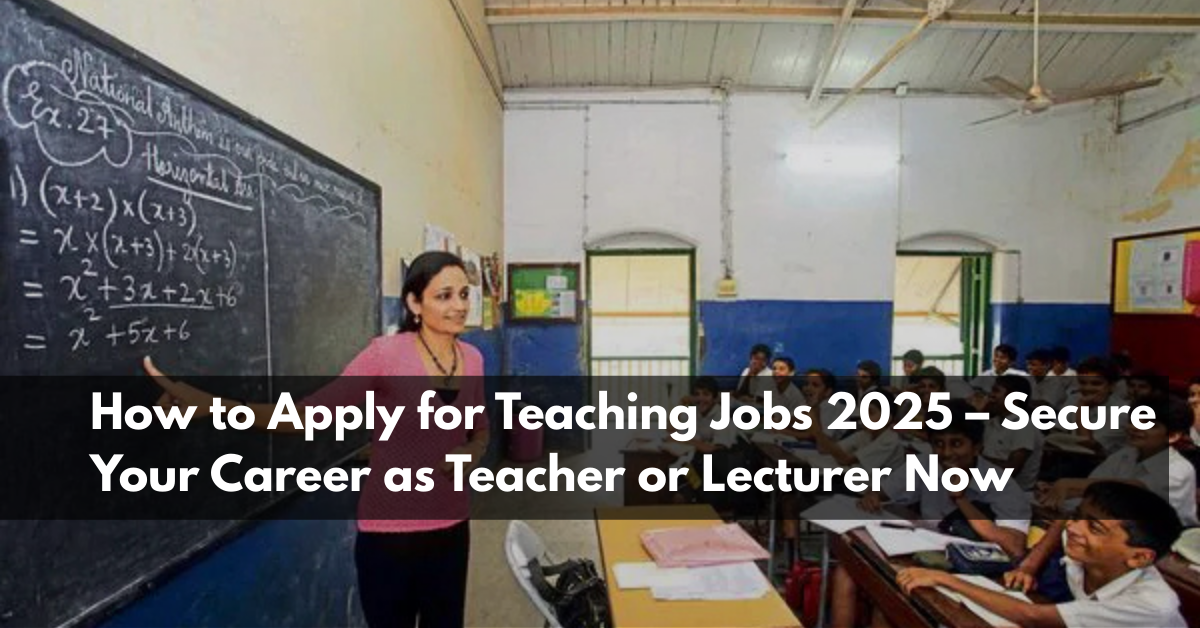
In 2025, teaching continues to be one of the most stable and respected career options in India, offering both job security and the opportunity to shape the future generation. With thousands of vacancies opening across government schools, private institutions, and higher education universities, aspirants have a golden chance to begin their teaching journey. Whether you aim to become a primary teacher, a secondary school educator, or a college lecturer, the process of applying has become more transparent and streamlined. From eligibility tests like CTET, TET, and UGC NET to direct recruitment by states, teaching aspirants can now easily apply online.
Why Consider a Teaching Career in 2025?
Teaching is more than just a profession—it’s a way of contributing to society. In 2025, the Indian government’s focus on education reforms under the National Education Policy (NEP) has created an increasing demand for teachers and lecturers. Some key reasons to choose teaching this year include:
- Job Security & Stability: Government jobs with permanent positions and pensions.
- Competitive Salaries: Attractive pay packages under the 7th Pay Commission.
- Social Recognition: Teachers are respected for shaping young minds.
- Work-Life Balance: Regulated working hours, vacations, and holidays.
- Career Growth: Opportunities for promotions and academic research.
Types of Teaching Jobs Available
- Primary Teachers (PRT): Handle classes 1–5, focusing on basic education.
- Trained Graduate Teachers (TGT): Teach classes 6–10 in specific subjects.
- Post Graduate Teachers (PGT): Teach classes 11–12 with subject specialization.
- College Lecturers/Assistant Professors: Deliver undergraduate/postgraduate courses in universities.
- Skill Trainers/Vocational Educators: Impart industry-relevant training under government skill initiatives.
Eligibility Criteria for Teachers & Lecturers
Primary Teacher (PRT)
- Qualification: D.El.Ed or B.Ed with TET qualification.
- Age Limit: 18–35 years (varies by state).
TGT/PGT Teachers
- Qualification: Graduation or Post-Graduation with B.Ed.
- Exam Requirement: CTET or relevant state TET.
- Age Limit: 21–40 years.
Lecturer/Assistant Professor
- Qualification: Master’s degree with at least 55% marks.
- Exam Requirement: UGC NET/State Eligibility Test.
- Age Limit: 21–40 years (with relaxations for reserved categories).
Step-by-Step Guide: How to Apply for Teaching Jobs in 2025
- Identify the Job Type & Eligibility
- Decide whether you’re applying for school-level (PRT/TGT/PGT) or college-level lecturer/professor positions.
- Register on the Official Portal
- Visit the recruitment body’s website (e.g., KVS, NVS, State PSC, or NTA).
- Create an account using a valid email ID and phone number.
- Fill the Application Form
- Enter academic details, work experience, and personal information.
- Choose exam centers (if applicable).
- Upload Required Documents
- Recent passport-sized photo, signature, and scanned certificates.
- Pay the Examination/Application Fee
- Online payment via debit/credit card, UPI, or net banking.
- Download Confirmation Slip
- Save/print the acknowledgement form for reference.
- Track Notifications
- Regularly check admit card release dates, exam schedules, and updates.
Recruitment Exams for Teaching Jobs in 2025
- CTET 2025: Essential for central school teachers.
- UPTET, BTET, HTET, and other state-level TETs.
- UGC NET 2025: Mandatory for college lecturers.
- KVS & NVS Recruitment Exams.
- State PSC Lecturer Exams.
Selection Process
The recruitment process generally involves:
- Written Examination – To test subject knowledge, pedagogy, and aptitude.
- Interview/Teaching Demo – For evaluating classroom handling skills.
- Document Verification – Ensuring authenticity of educational records.
For lecturers, academic records and research contributions also carry weightage.
Salary Structure in 2025
- Primary Teachers (PRTs): ₹35,000 – ₹50,000 per month.
- TGT/PGT Teachers: ₹47,000 – ₹80,000 per month.
- College Lecturers/Professors: ₹57,700 – ₹2,18,000 per month.
Additional Benefits:
- Dearness Allowance (DA), HRA, Medical Benefits.
- Pension and retirement benefits.
- Paid leaves and vacation allowances.
Tips to Crack Teaching Recruitment Exams
- Study NCERT Books: Strengthen basics for pedagogy and subject knowledge.
- Practice Teaching Aptitude Questions: Essential for CTET/TET exams.
- Refer to Previous Year Papers: Understand exam pattern and difficulty level.
- Focus on NEP 2020 & Current Educational Policies.
- Improve Communication Skills: Crucial for lecturer-level interviews.
- Attempt Mock Tests: Helps manage time during exams.
Career Growth Opportunities
Teaching is one of the few professions with a well-defined career path:
- School Teachers: PRT → TGT → PGT → Vice Principal → Principal.
- Lecturers: Assistant Professor → Associate Professor → Professor → Dean/Vice Chancellor.
- Special Opportunities: Teacher training, research fellowships, administrative roles.
Challenges Teachers May Face
- Managing overcrowded classrooms.
- Keeping up with changing syllabi and digital education tools.
- Balancing administrative duties with teaching.
- Pressure of exam results and student performance.
Why 2025 is the Best Year to Apply
- Backlog vacancies are being filled in multiple states.
- Digital classrooms require more trained teachers.
- Higher demand for lecturers due to NEP 2020 reforms.
- Government initiatives to improve literacy and skill development.
Conclusion
Teaching jobs in 2025 offer one of the most rewarding and stable career opportunities for aspiring educators. Whether your dream is to become a school teacher guiding young children or a lecturer shaping higher education, the application process is now easier than ever. With the right qualifications, preparation, and timely application, candidates can secure their position in this noble profession. The teaching journey not only ensures financial security but also provides immense satisfaction by contributing to the growth of society. If you are eligible and passionate about education, apply today and take the first step toward a meaningful career.
🔗 Learn more about Teaching in India on Wikipedia.
