

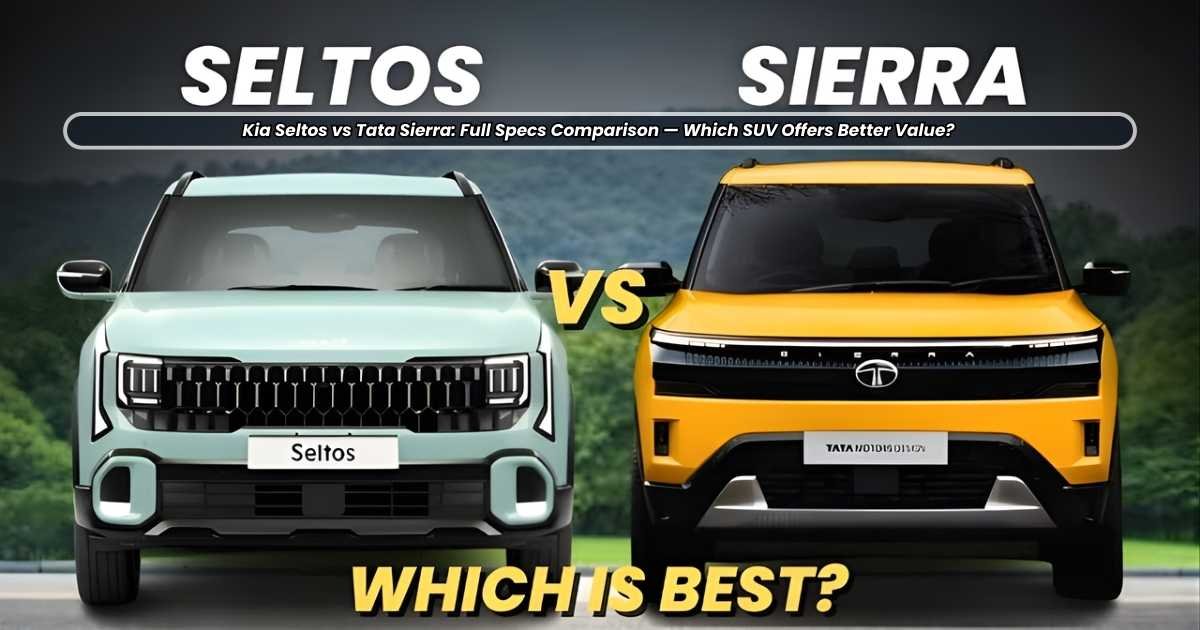
Kia Seltos vs Tata Sierra: Full Specs Comparison — Which SUV Offers Better Value?
The Indian automotive landscape is currently experiencing a renaissance, driven primarily by the relentless surge in demand for Sport Utility Vehicles (SUVs). This segment, which once primarily consisted of rugged, body-on-frame vehicles, has evolved dramatically, now encompassing sleek, feature-packed monocoque crossovers that cater to urban, suburban, and highway usage alike. In this highly competitive mid-size SUV segment, two names stand out: the established segment disruptor, the Kia Seltos, and the modern-day revival of an Indian icon, the Tata Sierra. Both vehicles, though representing different design philosophies—one prioritizing cutting-edge technology and global flair, the other championing rugged practicality and Indian heritage—are poised to fiercely compete for the aspirational Indian buyer.
This comprehensive comparison aims to move beyond superficial aesthetics and delve deep into the technical specifications, dimensional differences, powertrain options, feature sets, and core value propositions of the latest iterations of the Kia Seltos (post-2025 update) and the all-new Tata Sierra (ICE model, recently launched/detailed). The Indian consumer is more discerning than ever, demanding a perfect blend of performance, safety, features, and fuel efficiency at a competitive price point. The ultimate question is not just which SUV is technically superior, but which one offers the most compelling and complete package for the diverse needs of the modern Indian family. This detailed analysis will provide the necessary data and insights to help prospective buyers make an informed decision, dissecting the merits of South Korean engineering finesse against the robust, homegrown innovation of Tata Motors.
Design Philosophy and Road Presence Examination
A vehicle’s initial impact is defined by its design, and here, the Kia Seltos and the Tata Sierra take decidedly different approaches. Their exteriors speak volumes about their respective brand identities and the type of buyer they aim to attract. This design comparison is crucial because, in the Indian market, road presence and styling often outweigh subtle technical differences.
The Kia Seltos has, since its launch, been a poster child for modern, aggressive, and contemporary design. Its post-2025 iteration is even more assertive, incorporating design cues from Kia’s global flagship SUVs. The front fascia is dominated by a wider, more sculpted version of Kia’s signature ‘Tiger Nose’ grille, now flanked by distinctive, vertically oriented LED DRLs and squared-off headlamp clusters. The overall look is sharp, sophisticated, and undeniably urban-centric. Moving to the side, the Seltos maintains its sporty stance, featuring flush-fit door handles, prominent shoulder lines, and new 18-inch alloy wheels that contribute to its dynamic profile. At the rear, the connected LED taillamps and revised bumper add a touch of premium modernity. The Seltos is a design that screams ‘global’ and ‘tech-forward,’ appealing directly to the younger, style-conscious metropolitan buyer.
In stark contrast, the Tata Sierra capitalizes on the deep nostalgia and rugged legacy of its iconic predecessor while reinterpreting it for the modern age. The Sierra’s design is more upright, boxy, and muscular, embodying a classic SUV silhouette. It commands attention with its height and width. The front features a connected LED light bar and the main headlamps positioned lower down on the fascia, giving it a powerful, broad stance. The most distinctive design element, a clear nod to the original, is the reimagined ‘Alpine window’ or the signature B-pillar and wraparound glass effect, which, though partially blacked-out in the new model, maintains that unmistakable identity. The flush door handles, large 19-inch dual-tone alloy wheels, and the bold ‘Sierra’ badging reinforce its presence. The Sierra is not just a car; it’s a statement about heritage and a robust, commanding road demeanor, appealing to buyers who value a strong, timeless, and rugged look.
When looking at the sheer road presence, the Sierra’s greater height (approximately 1,715 mm vs. 1,635 mm for Seltos) and width (approximately 1,841 mm vs. 1,830 mm for Seltos) give it a visually larger and more intimidating stance. While the Seltos is longer (approximately 4,460 mm vs. 4,340 mm for Sierra), the Sierra’s sheer volume and upright design translate into a superior sense of command on the road, a factor highly prized by Indian SUV buyers. The choice here is subjective: refined, global sophistication (Seltos) versus bold, classic, and high-stature ruggedness (Sierra).
Dimensions and Cabin Architecture: Space and Practicality
In a country where cars are often used as multi-purpose family vehicles, internal space, boot capacity, and overall dimensions are critical decision-making factors. The on-paper dimensional differences between the Kia Seltos and the Tata Sierra translate directly into tangible differences in cabin and boot practicality.
Exterior Dimensions
| Parameter | Kia Seltos (2025 Spec) | Tata Sierra (2025 Spec) | Difference | Advantage |
| Length | 4,460 mm | 4,340 mm | Seltos is 120 mm Longer | Seltos (Aids stability, visual length) |
| Width | 1,830 mm | 1,841 mm | Sierra is 11 mm Wider | Sierra (Aids shoulder room) |
| Height | 1,635 mm | 1,715 mm | Sierra is 80 mm Taller | Sierra (Aids headroom, road presence) |
| Wheelbase | 2,690 mm | 2,730 mm | Sierra is 40 mm Longer | Sierra (Aids legroom, ride comfort) |
| Ground Clearance | 190 mm | 205 mm | Sierra is 15 mm Higher | Sierra (Aids rough road capability) |
The dimensional comparison clearly indicates that the Tata Sierra is the more spacious and ruggedly practical SUV. Its substantially longer wheelbase, greater width, and superior height directly translate to better cabin dimensions, particularly in terms of headroom and shoulder room for both front and rear passengers. The 40 mm longer wheelbase of the Sierra is a significant factor that will contribute to superior rear-seat legroom and a potentially more settled ride quality, especially on highway journeys. Furthermore, the Sierra’s 15 mm higher ground clearance (205 mm vs. 190 mm) offers a considerable advantage when navigating the unpaved roads and large speed breakers common in India.
Interior Layout and Boot Capacity
The interior architecture of the two SUVs reflects their exterior design philosophies.
The Seltos cabin is modern, driver-focused, and highly ergonomic. It features a seamless, connected dual-screen setup (likely two 12.3-inch displays), giving it a futuristic, horizontal feel. The seating position is comfortable and car-like, offering excellent forward visibility. While the cabin is spacious, the Seltos’s boot space, at approximately 447 litres, is competent but not segment-leading. The overall fit-and-finish and quality of materials are typically high, emphasizing a premium, refined feel.
The Sierra cabin, due to its increased height and longer wheelbase, offers a genuinely expansive feel. The seating is more upright, giving occupants that commanding, traditional SUV view of the road. Tata Motors has focused on maximizing utility, which is immediately evident in the massive boot capacity of approximately 622 litres. This 175-litre difference in boot space gives the Sierra a significant advantage in sheer practicality for long family trips or large luggage demands. The Sierra also features a triple-screen dashboard layout (including a dedicated co-driver entertainment screen on top trims), adding a futuristic yet spacious aesthetic. The focus is on robust comfort, expansive room, and high utility.
Verdict on Space: The Tata Sierra is the undeniable winner in terms of interior space and utility, offering superior headroom, a longer wheelbase for better legroom, and a significantly larger boot.
Powertrain Options and Driving Dynamics
Engine and transmission choices are crucial, influencing performance, fuel efficiency, and overall driving experience. Both the Kia Seltos and the Tata Sierra offer a wide array of powertrains, catering to different buyer needs, from efficient city driving to powerful highway cruising.
Engine Specification Comparison
| Parameter | Kia Seltos (2025 Spec) | Tata Sierra (2025 Spec) |
| 1.5L Naturally Aspirated Petrol | 1.5L NA Smartstream Petrol | 1.5L NA Revotron Petrol |
| Power/Torque (NA Petrol) | 113 bhp / 144 Nm | 104 bhp / 145 Nm |
| Transmission (NA Petrol) | 6-speed MT / IVT (CVT) | 6-speed MT / 7-speed DCT |
| 1.5L Turbo Petrol | 1.5L T-GDi Smartstream Petrol | 1.5L TGDi Hyperion Petrol |
| Power/Torque (Turbo Petrol) | 158 bhp / 253 Nm | 158 bhp / 255 Nm |
| Transmission (Turbo Petrol) | 6-speed iMT / 7-speed DCT | 6-speed AT (Torque Converter) |
| 1.5L Diesel | 1.5L CRDi VGT Diesel | 1.5L Kryojet Diesel |
| Power/Torque (Diesel) | 114 bhp / 250 Nm | 116 bhp / 260 Nm (Up to 280 Nm on AT) |
| Transmission (Diesel) | 6-speed MT / 6-speed AT (Torque Converter) | 6-speed MT / 6-speed AT (Torque Converter) |
Performance Analysis
-
Naturally Aspirated Petrol: The Seltos holds a slight edge in power (113 bhp vs 104 bhp) for its base petrol engine, but the Sierra’s torque is delivered at a much lower RPM (2,100 rpm vs 4,500 rpm for Seltos), which is often more useful for city start-stop traffic. The Sierra offers a more advanced 7-speed DCT automatic with its NA petrol, while the Seltos uses a CVT.
-
Turbo Petrol: Both SUVs offer nearly identical power and torque figures for their high-performance turbo-petrol engines (158 bhp / $\approx$255 Nm). The key difference is the automatic transmission. The Seltos uses a quick-shifting 7-speed DCT, known for its performance. The Sierra, conversely, opts for a robust 6-speed Torque Converter Automatic (AT), which is often preferred for its reliability and smoother low-speed operation, although it may be slightly less performance-oriented than the DCT.
-
Diesel: The Tata Sierra clearly takes the lead in the diesel segment. Its diesel engine offers superior power (116 bhp vs 114 bhp) and significantly higher torque (260 Nm, potentially up to 280 Nm on the AT variant vs 250 Nm for Seltos). This higher torque figure, especially on the AT version, makes the Sierra diesel a more potent and effortless machine for highway cruising and climbing steep gradients, which is a major draw for long-distance drivers.
Driving Dynamics
-
Kia Seltos: Built on a monocoque platform, the Seltos is known for its car-like handling, refined ride quality, and quick responsiveness. It feels nimble and easy to drive in the city, with suspensions tuned for a balance of comfort and agility.
-
Tata Sierra: Also built on a monocoque platform, the Sierra, with its longer wheelbase, taller stance, and higher ground clearance, is expected to offer a more plush, comfort-oriented ride, soaking up bumps and undulations with greater authority. While it may not feel as sporty as the Seltos in sharp corners, its robust build and expected suspension tuning will offer a more composed and solid feel, aligning with the traditional ‘built-like-a-tank’ reputation of Tata vehicles.
Verdict on Powertrain: The Kia Seltos offers a more refined and technologically advanced transmission lineup (CVT, DCT). However, the Tata Sierra offers slightly more potent and high-torque diesel and turbo-petrol engines, providing better highway cruising capability and potentially a more robust, long-term feel, especially with its use of the torque converter automatic.
Features, Technology, and Safety Commitment
In this segment, the war is won or lost on the feature list. Both manufacturers have armed their SUVs with an arsenal of technology, but they prioritize different aspects.
Key Technology and Comfort Features
| Feature | Kia Seltos (2025 Spec – Top Trim) | Tata Sierra (2025 Spec – Top Trim) | Advantage |
| Infotainment Screen | 12.3-inch Digital Touchscreen | 12.3-inch Central Touchscreen | Tie |
| Driver Display | 10.25-inch Digital Cluster | 10.25-inch Digital Cluster | Tie |
| Co-Passenger Screen | No | 12.3-inch Dedicated Co-Driver Screen | Sierra |
| Sound System | 8-Speaker Bose Premium Audio | 12-Speaker JBL Black with Dolby Atmos | Sierra |
| Sunroof | Panoramic Sunroof | Panoramic Sunroof | Tie |
| ADAS | Level 2 ADAS (Comprehensive suite) | Level 2+ ADAS (22 intelligent features) | Tie/Slight Sierra Edge |
| Ventilated Seats | Front Ventilated Seats | Front Ventilated Seats (with Memory) | Tie |
| Driver Seat | Powered Driver Seat | 6-Way Powered Driver Seat with Memory | Sierra |
| Cabin Feature Unique | Head-Up Display (HUD) | HypAR HUD with Multicolour Guides | Sierra (HypAR HUD) |
| Connectivity | Connected Car Tech | iRA Connected Car Tech with 5G Connectivity | Sierra (5G and OTA updates) |
| Boot Opening | Standard | Powered Tailgate with Gesture Control | Sierra |
| Climate Control | Dual-Zone Auto AC | Dual-Zone Auto AC | Tie |
The feature comparison reveals that the Tata Sierra appears to have a slight technological and luxury edge in its top-spec variants. The introduction of the industry-first dedicated 12.3-inch co-driver entertainment screen, the superior 12-speaker JBL sound system with Dolby Atmos, and a powered tailgate elevates the Sierra’s cabin experience to a more luxurious, premium level. The integration of 5G connectivity and advanced Over-The-Air (OTA) updates also future-proofs the Sierra’s tech stack.
The Kia Seltos is by no means lacking; its feature list is comprehensive, including a Level 2 ADAS suite, ventilated seats, and excellent digital integration. However, the Sierra takes the concept of a feature-loaded SUV a step further, focusing on in-car entertainment and passenger comfort (e.g., powered driver seat with memory, HypAR HUD).
Safety and Build Quality
Safety is the single most important consideration for the modern Indian car buyer, and both manufacturers have placed a high priority on this aspect.
-
Kia Seltos: The latest Seltos is equipped with a comprehensive set of safety features:
-
Standard Safety: 6 Airbags, ABS with EBD, Electronic Stability Control (ESC), Hill-Start Assist.
-
Advanced Safety: Level 2 ADAS, 360-degree camera, all-wheel disc brakes. The Seltos’s platform and structure have been continually refined, leading to an excellent safety reputation.
-
-
Tata Sierra: Tata Motors is renowned for prioritizing vehicle build quality and structural integrity, consistently achieving high Global NCAP safety ratings across its portfolio. The Sierra continues this legacy:
-
Standard Safety: 6 Airbags, ABS with EBD, ESC, Hill Assist, ISOFIX mounts.
-
Advanced Safety: Level 2+ ADAS (22 intelligent features), 360-degree camera.
-
While both SUVs offer Level 2 ADAS, the Tata Sierra’s potential advantage lies in its expected structural robustness. Tata’s vehicles are often perceived as being built ‘tougher,’ a psychological advantage that resonates deeply with Indian buyers. Assuming both vehicles perform exceptionally in safety ratings, the Sierra might appeal more to those who prioritize structural integrity and a solid, heavier build feel, while the Seltos offers advanced, tech-driven safety.
Pricing and Value Proposition
Ultimately, the decision comes down to the price-to-value ratio. Given the detailed specifications available, the expected pricing of both SUVs places them in direct competition across the mid-size SUV segment.
Expected Price Range (Ex-Showroom, Delhi – Approximate)
| Model | Variant Range | Expected Price Range (Ex-Showroom) |
| Kia Seltos (2025) | HTE (NA Petrol MT) to X-Line (Turbo DCT/Diesel AT) | $\approx$ ₹10.79 Lakh to $\approx$ ₹19.81 Lakh |
| Tata Sierra (2025) | Smart+ (NA Petrol MT) to Accomplished+ (Diesel AT) | $\approx$ ₹11.49 Lakh to $\approx$ ₹18.49 Lakh (Top trims TBD) |
Note: The Sierra’s highest variants, Accomplished and Accomplished+, are expected to push the price closer to the ₹20.0-₹21.5 Lakh mark, placing it slightly above the Seltos’s highest variants in terms of sheer premium positioning.
Value Analysis
-
Lower to Mid-Spec Variants ($\approx$ ₹11 Lakh to ₹15 Lakh):
-
Kia Seltos: Offers a greater number of variants in this range, providing more choice and feature customization. Its base NA Petrol engine is slightly more powerful. The Seltos is generally viewed as offering excellent features even at lower price points.
-
Tata Sierra: Starts slightly higher but offers immediately visible benefits: more space, a larger boot, and better ground clearance from the base models. The Sierra’s base price point is focused more on providing a commanding, rugged SUV experience.
-
-
Higher-Spec Variants ($\approx$ ₹16 Lakh to ₹20 Lakh):
-
Tata Sierra offers superior value here due to its segment-first features like the co-driver screen, superior sound system, more powerful diesel engine, and overall greater cabin volume. For the buyer who wants the most physical and technological presence for their money, the Sierra is highly competitive.
-
Kia Seltos continues to offer a refined, established package with advanced transmissions (DCT, IVT) and a known track record for reliability and high service standards. Its value lies in proven performance, brand refinement, and a seamless ownership experience.
-
Value Verdict:
-
For Maximum Cabin Space, Boot Capacity, and Cutting-Edge Luxury Tech (like the co-driver screen), the Tata Sierra offers superior value, especially for family-oriented buyers who prioritize room and advanced entertainment.
-
For Driving Dynamics, Refinement, Multiple Proven Powertrain Combinations, and a slightly lower entry price, the Kia Seltos offers a compelling and dependable value proposition.
Frequently Asked Questions (FAQ)
Is the Tata Sierra bigger than the Kia Seltos?
The Tata Sierra is physically wider and taller than the Kia Seltos, and it also features a longer wheelbase (2,730 mm vs. 2,690 mm) and significantly higher ground clearance (205 mm vs. 190 mm). While the Seltos is 120 mm longer overall, the Sierra’s dimensions translate to superior interior width, headroom, and rear legroom, as well as a much larger boot space (622 litres vs. 447 litres). Therefore, the Sierra offers a more spacious and commanding cabin.
Which SUV offers better engine and transmission options?
Both offer a 1.5L Naturally Aspirated Petrol, a 1.5L Turbo Petrol, and a 1.5L Diesel.
-
Seltos offers a wider range of advanced automatics: CVT (IVT) with NA Petrol and 7-speed DCT with Turbo Petrol.
-
Sierra offers slightly more powerful and torquier Diesel engine options and pairs its Turbo Petrol with a more robust 6-speed Torque Converter Automatic (AT), which is generally more reliable and smooth in stop-go traffic compared to the DCT. The Seltos offers more choice, but the Sierra offers more torque, especially in diesel.
Which car is safer in terms of structural build quality?
Both the Kia Seltos and the Tata Sierra are expected to be very safe, offering 6 airbags as standard and the full Level 2 ADAS suite on top trims. Tata Motors, however, has an established reputation in India for achieving high Global NCAP ratings and designing vehicles with a perceived superior structural strength and heavier build. While the Seltos is also structurally sound, the Sierra might appeal more to those who prioritize the robust, proven build philosophy of Tata Motors.
Does the Tata Sierra have a specific feature advantage over the Kia Seltos?
Yes, the top-end Tata Sierra variants offer several segment-leading and superior features, including a 12.3-inch dedicated co-driver entertainment screen, a premium 12-speaker JBL audio system with Dolby Atmos, a powered tailgate with gesture control, and 5G connectivity for faster connected car services and Over-The-Air (OTA) updates.
What is the primary difference in their value proposition?
The Kia Seltos offers better value for the buyer who prioritizes driving refinement, a huge selection of engine/gearbox combinations, a proven track record, and a lower entry price point. The Tata Sierra offers better value for the buyer who prioritizes maximum space, a commanding road presence, a massive boot, and cutting-edge luxury and entertainment technology.
Final Verdict and Better Value Determination
The face-off between the Kia Seltos and the Tata Sierra is a compelling battle between two distinct schools of thought in the mid-size SUV segment. The final decision on which SUV offers better value hinges entirely on the buyer’s priorities.
Choose the Kia Seltos if you value:
-
Driving Refinement and Experience: Its use of the 7-speed DCT and CVT, coupled with its car-like handling, makes it feel more nimble and sporty.
-
Proven Track Record and Reliability: The Seltos has been a highly successful product in India for years, with an established and extensive service network.
-
A Broader Range of Powertrain Combinations: The Seltos offers a few more options in its lineup, allowing for finer customization of the driving experience.
-
Sophisticated, Urban Design: A sleek, modern, and globally recognized styling language.
Choose the Tata Sierra if you value:
-
Maximum Space and Utility: The longer wheelbase, greater width and height, and cavernous 622-litre boot make it the undisputed choice for large families and luggage.
-
Commanding Road Presence and Ruggedness: Its upright, boxy stance and high ground clearance give it a genuine SUV feel and better capability on challenging Indian roads.
-
Cutting-Edge Technology and Luxury: The dedicated co-driver screen, JBL sound system, and 5G connectivity push the interior experience into a more premium segment, offering greater value in terms of high-tech features.
-
The Assurance of Structural Integrity: Tata’s reputation for building solid, safe cars provides a strong psychological edge.
The Value Determination
Based on the detailed comparison, the Tata Sierra edges out the Kia Seltos in offering a marginally better overall value proposition for the typical family-oriented Indian SUV buyer. This conclusion is driven by the Sierra’s quantifiable advantages in the most critical areas for a family SUV:
-
Superior Space and Practicality: The 175-litre boot space advantage and superior cabin dimensions offer immediate, tangible value for family use.
-
Feature Overload: The segment-first co-driver screen and superior audio system, along with advanced connectivity, place the Sierra a step ahead in the technology and luxury race.
-
Engine Robustness: The more potent diesel engine (up to 280 Nm torque) and higher ground clearance offer better utility and less stress on long-distance or rough-road travel.
While the Seltos is a masterclass in refinement and offers fantastic gearbox options, the Tata Sierra leverages its iconic design, focuses heavily on structural integrity, and introduces game-changing luxury features, all while providing a larger, more commanding footprint. For the buyer who wants the biggest, most feature-rich, and most spacious family SUV that honors an Indian legacy, the Sierra delivers the superior overall package for the price.
